
One company card for your whole team: consistent contact details, updated once
When everyone prints their own cards, your brand drifts and your details go stale at different speeds. One shared card design fixes both.
A small team's contact details are messier than they look. One person has last year's phone number on their cards, another used a different logo, a third never got round to ordering any and hands out a scrap of paper. To the customer it does not read as a tidy business — it reads as several people who happen to share a van livery. A single company card puts everyone on the same page.
The problem with everyone doing their own thing
Paper cards drift. Every reprint is a chance for the logo to be slightly wrong, the phone number to be a version out of date, or the job title to be whatever that person fancied that week. Multiply small inconsistencies across a crew and your brand looks fuzzy at exactly the moment you want to look established and reliable.
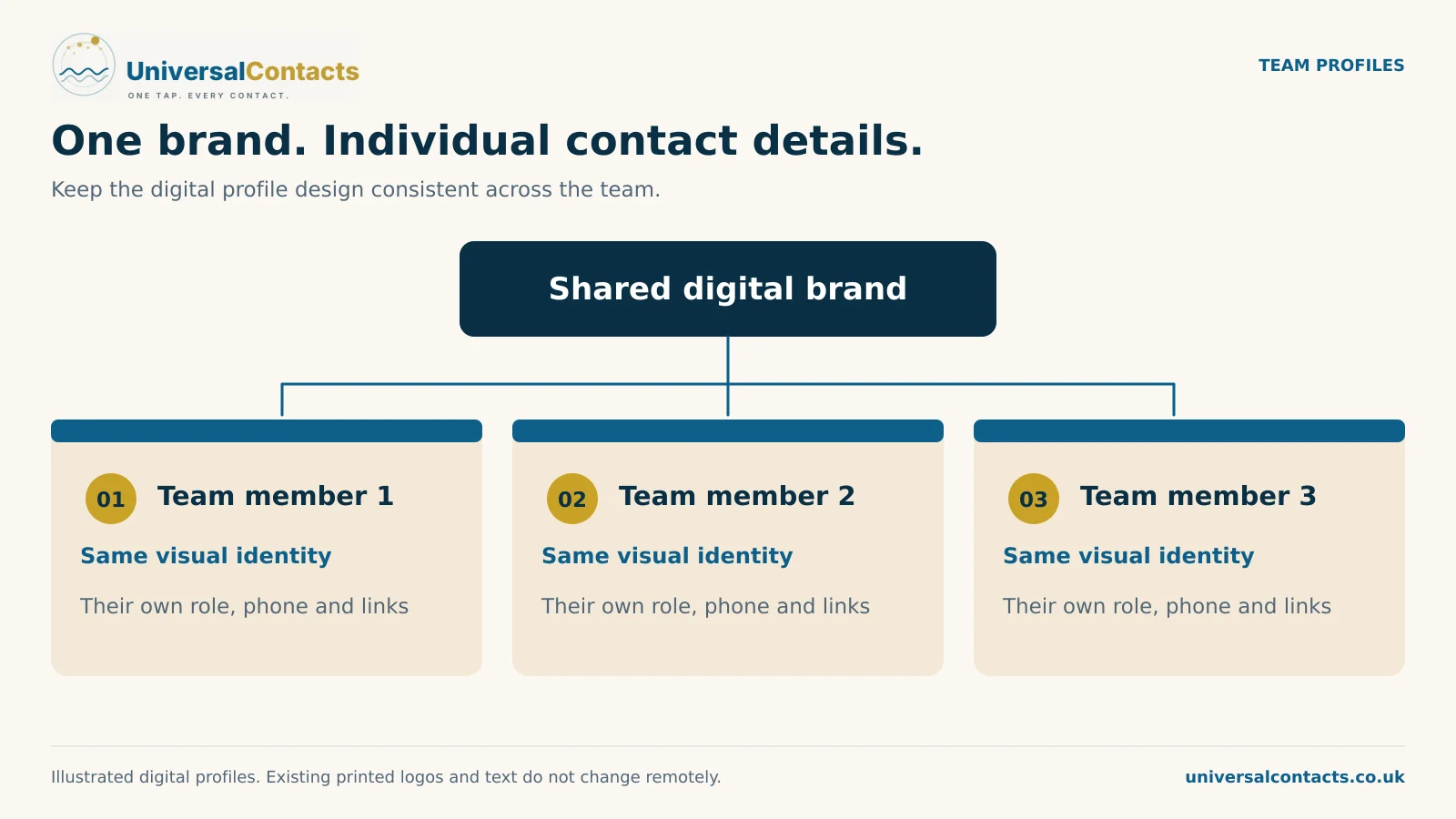
Design it once. Everyone inherits it.
You design the company card once in the Design Studio and save it as your template. From then on, anyone you bring on starts from it automatically — your colours and your logo already in place before they have typed anything. They fill in their own name, role and direct line. Nobody has to be sent a brand guide, and nobody has to be chased for getting it wrong.
Brand-locked, so it stays right
If you want it held tighter than good intentions, lock it. With the brand locked, teammates can edit their own name, role and contact details and nothing else — the logo and colours are not theirs to change. It is the difference between asking everyone to match the template and knowing that they do.
- One saved company template that new joiners start from automatically.
- Brand-lock, so the logo and colours cannot be edited by the person carrying the card.
- Individual profiles: each person keeps their own name, photo and direct line.
- A card for the company itself — your logo and company details on their own link and QR, separate from anybody's personal card.
- An activity log of invites, joins, removals and brand changes, and a team list you can export whenever you like.
Getting the crew on it
Invite people by email one at a time, share a join link in the group chat, or paste in a whole list and bulk-invite it. You can also order a branded card for someone straight from the roster. However they arrive, their card links itself to their profile the moment they finish setting up — there is no step where you have to match cards to people by hand.
Update once, everyone changes
This is where a shared card earns its keep. Move office, change the main number, launch a new website or update the company logo, and you change it in one place. Change the company colours or the logo and every teammate on the company brand re-brands automatically — no collecting everyone's cards to reprint, no one handing out last year's address for six months.
Leavers are worth saying out loud, because most systems handle it badly. When someone leaves your organisation their card does not die and it does not keep flying your colours either — it simply becomes their own personal card. They keep the contact details people already have for them; you stop being represented by someone who no longer works for you. Nobody has to have an awkward conversation about handing a card back.
Change the company details once, and every card your crew carries is up to date the same afternoon.
Who carries what
Different roles need different cards, and that is fine. Your customer-facing staff might carry a smart printed card to hand over, and everyone can keep a copy in Apple Wallet or Google Wallet so they are never caught without. A dual-chip card that also opens a door or gate is made to order rather than sold from the page: we check it against your access system first, and it is priced by quotation. Whatever they carry, it points at the same consistently branded profile, and every one of them can capture a lead back into your shared dashboard.
What it costs a team
Every profile is free, so you can set the whole team up at no cost and share by QR straight away. When you want physical cards, a team pack of five printed plastic cards is £95 as a one-off — add the five names at checkout and each person gets an invite that links their card to their profile automatically. Individual cards start at £24, with bamboo and metal finishes if particular roles want something different. There is no per-seat subscription; you buy the cards once.
Getting a crew set up
Start by building the company profile design and adding each person. Share by QR while you decide on materials, then order a team pack or a mix of finishes. Because the cards only ever point at the profiles you have already set up, ordering is the last step, not the thing you have to get perfect first.