
Your CV, one tap or scan
Link straight to your CV or hosted profile. No paper, no email-it-to-me-later.
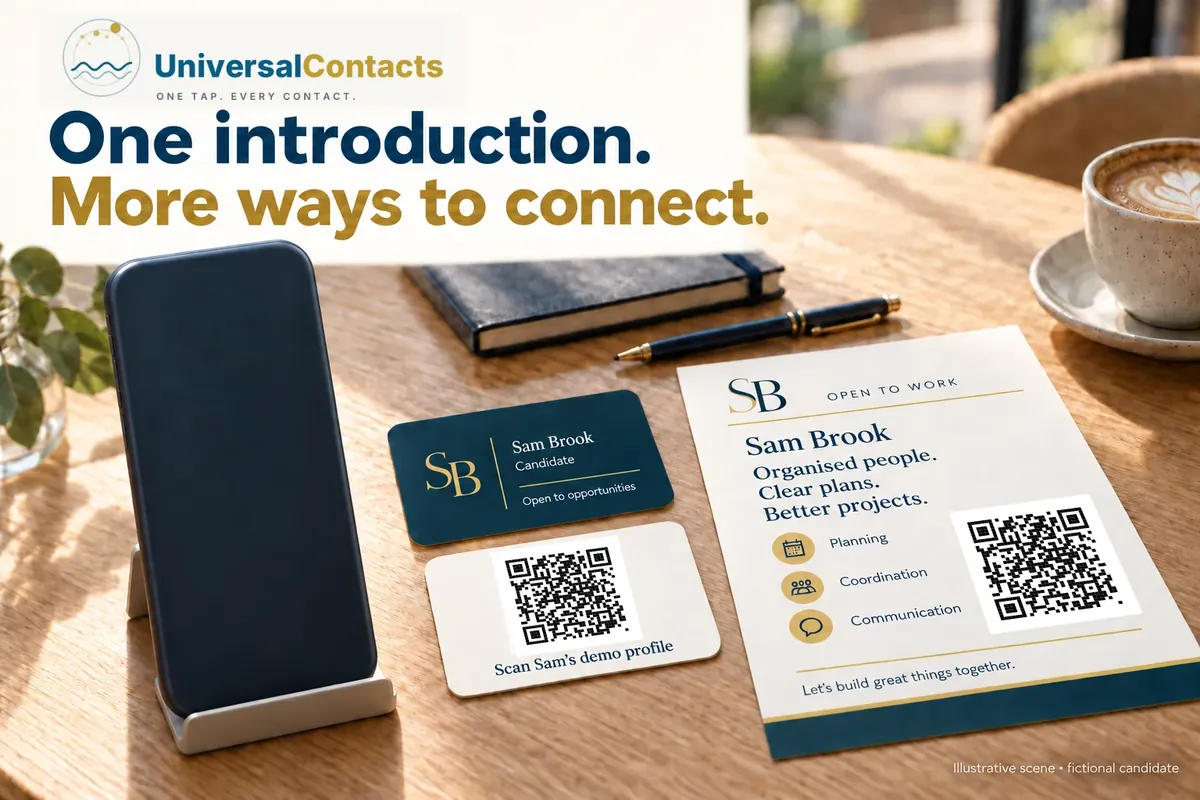
At a careers fair, an interview or a networking night, they tap your card — or scan the QR on it, if their phone has no NFC — and your CV, LinkedIn and contact details land on their phone before you have finished shaking hands. No paper CV to lose, no details to type.

Link straight to your CV or hosted profile. No paper, no email-it-to-me-later.
Send people to your LinkedIn, GitHub or portfolio the moment you meet them.
Phone, email and links land on their phone instantly, before the conversation ends.
New role, new CV, new number? Change it once. The card already knows.
It goes into a pile. By four o'clock the person on the stand has two hundred of them in a tote bag, and the ones that get read are the ones still on top. Nothing about the CV decides that — the order does.
A card changes which pile you are in, because there isn't one. They tap it, or scan the printed QR, and your CV, your LinkedIn and your portfolio are on their phone while you are still standing there. It is on the device they will actually be holding on the train home, rather than in a bag in a car boot.
It also removes the step that loses most people: nobody has to type your email address into anything. Every character somebody has to transcribe is a chance to get it wrong and a reason not to bother.

During a job hunt the CV is never finished. You tailor it for a role, you add the certificate that came through, you fix the thing a friend spotted. A printed card with a link on it is fixed at the moment it was printed; ours points at a code we resolve, so you update the destination and every card you have already handed out follows.
That includes the ones from a fair three weeks ago, which is usually when somebody actually gets round to looking.
Job hunting while employed is the normal case and it makes people reasonably nervous about a public profile. You can run more than one profile on a single account — one for the job hunt with the CV and portfolio on it, one ordinary one with your work details — and choose which a given card points at. You can also switch a card off from the dashboard entirely, at any moment, and it stops opening anything.
None of that requires a new account or a second card. The privacy controls cover what is visible and what is not.
The card does not become waste. Point it at your new work details and it is simply your contact card — same object, same code, different destination. That is worth saying because the obvious objection to buying a card for a job hunt is that the job hunt ends. What happens when your details change explains why that works.
£24 for plastic, £35 for bamboo, £59 for metal — paid once, posted free in the UK, with no subscription. The profile, the QR and the analytics are free whether you buy a card or not, so you can build the profile tonight and share it by QR at the next fair before spending anything. Full pricing.
This is the difference between a card you own and a card you are stuck with, and it is worth understanding before you buy anybody’s.
The web address is written onto the chip itself. That is why it is cheap, and it works fine — right up until something changes.
The chip carries a permanent code, and we decide what that code opens. The card is a key; the lock is ours to change.
Which is why we can sell you a card and then never charge you again: the thing that keeps it working is not a subscription, it is that the destination was never on the chip. What happens when you change your number goes through all three arrangements in full.
Your card tells you when a recruiter opened your profile, and lets them send their details back to start the conversation — no chasing, no wondering.
Anyone viewing your card can send their name and number straight back — no app, no account. Connections land in your dashboard.
See it in action →Views, taps and connections per card with a 30-day activity view. Included free.
See it in action →Email signature, video-call background and Apple Wallet or Google Wallet pass, generated from your live card.
See it in action →It is one card, bought once, and the thing it replaces is a stack of printed CVs that mostly get recycled. At a fair it is the difference between being in a pile and being on somebody's phone.
Every card has a printed QR as well as the chip, going to the same place. Older and locked-down work phones read the code with the camera.
You can run a separate profile for the job hunt and point the card at that, and you can switch a card off from your dashboard at any time so it stops opening anything at all.
Yes — point it at your new details and it becomes your ordinary contact card. The code stays the same; only the destination changes.
Cards for networking covers the same object outside a job hunt, and QR code sharing the scanning side.
A card is what you hand a recruiter. This is what sits on the table while you talk to somebody else.
A printed card with a live QR - your CV and portfolio behind it, updated without reprinting.
from £33 (50 cards)
On the table at a careers fair, so the stand works while you are mid-conversation.
from £19 (A5)
UK delivery £10.19, free over £100 of printed items. See the whole range, or put it in one basket.