
Google review cards: the honest way to ask, and the shortcut that breaks the rules
A card on the counter that takes a happy customer straight to your Google review page is one of the highest-return things a small business can own. A card that quietly filters out the unhappy ones is a liability.
Reviews decide who gets rung. For a cafe, a salon or a trade, the gap between 4.2 stars and 4.8 stars is the gap between being the second call and the first. And the single biggest reason good businesses have thin review counts is not that customers are unwilling — it is that nobody asked them at the moment they were pleased. Google review cards fix the asking; this piece is about doing it within the rules.
Why the moment matters more than the ask
The window is short. It is while the customer is still in the chair, still standing in the kitchen you have just fitted, still holding the coffee. An email two days later asks somebody to remember a feeling they have moved on from, then find your listing, then sign in, then write something. Most people will not, and it is nothing personal.
A card, a counter stand or a sign collapses all of that into one movement. They tap it, or point their camera at the QR — no NFC needed, no app for anybody — and they land on your write-a-review screen with the keyboard already up.
The shortcut you must not take
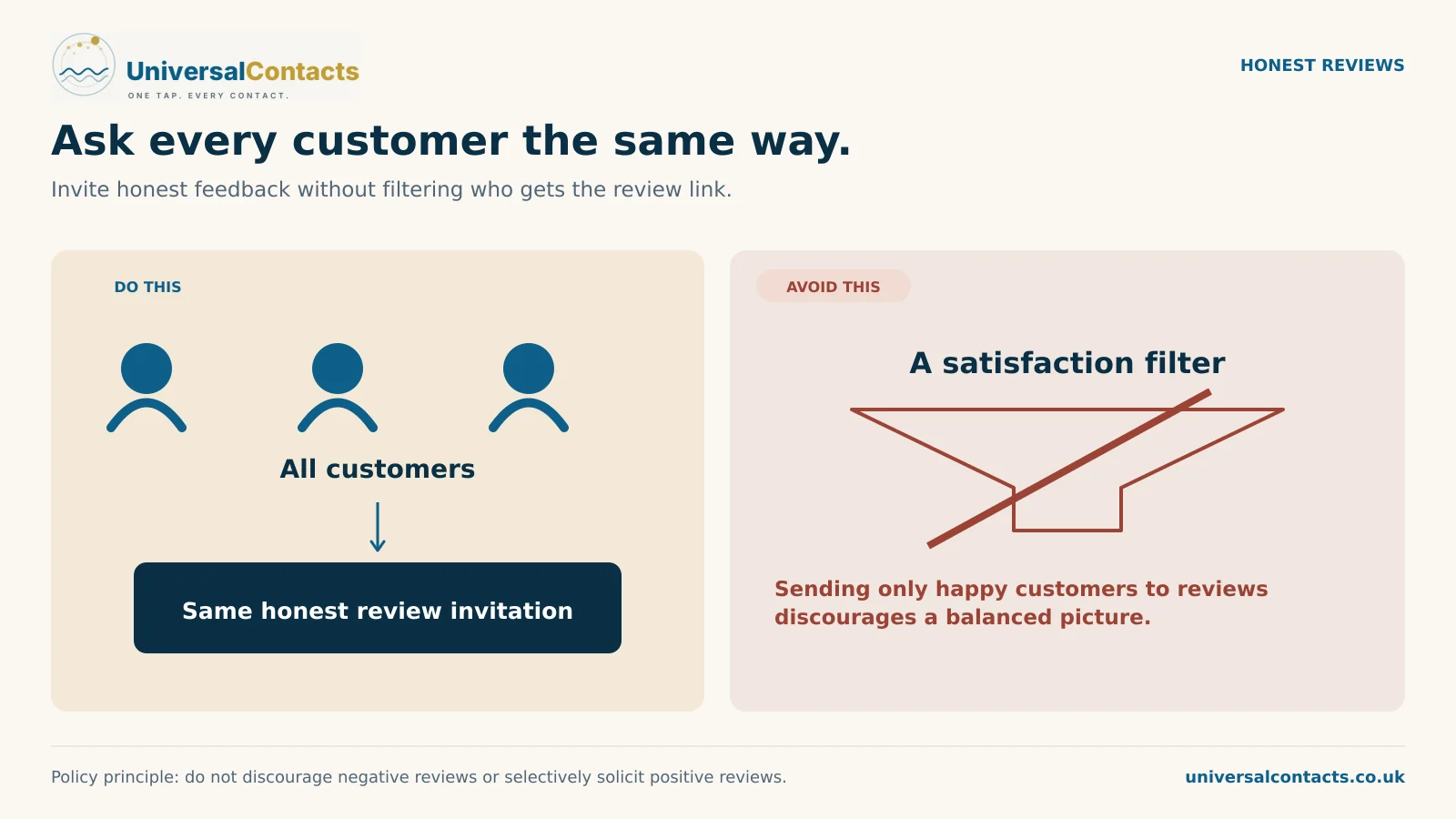
Some review tools do something clever-sounding: ask the customer how it went first, send the happy ones to Google and route the unhappy ones to a private feedback form instead. Your public rating goes up. Your actual service does not.
That is called review-gating and it is not a grey area. Google's policy says it outright: merchants must not “discourage or prohibit negative reviews, or selectively solicit positive reviews from customers”, and listings have been restricted for fake engagement. In the UK, fake and misleading reviews were added to the banned practices list by the Digital Markets, Competition and Consumers Act 2024, in force since 7 April 2025 and now enforceable by the CMA directly. In the United States, the FTC's 2024 rule separately targets review suppression, including misrepresenting that the reviews on display are all the reviews received. A tool that offers gating as a feature is offering to take the risk with your listing, not theirs.
If a review tool asks how it went before deciding where to send the customer, that is not a satisfaction check. That is a filter, and it is the part that gets you in trouble.
What ours does instead
Everyone goes to the same place. Tap or scan, land on your Google review page, write whatever you actually think. There is no pre-screen, no sentiment question, no fork in the road — which means there is nothing for Google to object to and nothing for a regulator to take an interest in.
- One destination for every customer, happy or not.
- No app for the customer, and no NFC required — the printed QR does the same job.
- Every tap and scan counted in your dashboard, so you can see which card, stand or sign is doing the work.
- A card, a counter stand or a metal sign, so the thing suits the room it lives in.
The uncomfortable part, said out loud
If you make it this easy to leave a review, you will occasionally get one you do not enjoy. That is the deal, and it is a better deal than it sounds. A wall of nothing but five stars reads as bought — shoppers have learned to distrust it. A strong average with the odd three-star and a calm reply underneath reads as a real business run by real people, and it converts better. The fix for a bad review has always been the same thing: be good, then answer it well.
What it costs
A review card is a one-off, like the rest of our cards, and the dashboard that counts the taps and scans is part of the free profile. There is no per-review fee and no monthly platform charge, because charging you a subscription to ask your own customers a question would be a strange way to earn a living.
Sources
- Google — Prohibited & restricted content (Maps user-generated content policy) — the fake engagement and rating manipulation rules, including selective solicitation of positive reviews.
- Competition and Markets Authority — new consumer protection regime, in force 7 April 2025 — includes the ban on posting and commissioning fake reviews.
- Federal Trade Commission — Rule on the Use of Consumer Reviews and Testimonials, 14 August 2024 — United States only; covers review suppression and misrepresenting the review set.